You finish a task and immediately reach for your phone. Before you have decided what you want to see, a screen is already in your hand. The next thing has begun without much of a choice.
There is nothing unusual about this. Much of a day depends on familiar movements. We would struggle if we had to reconsider every step. Yet a familiar movement can also carry us somewhere we did not intend to go. A brief check becomes a long visit. A moment of uncertainty becomes another purchase, another argument, or another promise.
Consider the small interval between noticing an urge and following it. You do not have to make the urge disappear. You can simply ask what the action is for. Perhaps you need to answer a message. Perhaps you want company. Perhaps you are avoiding an uncomfortable task. These are different needs, even when the same thumb movement answers all of them.
Attention begins with that distinction. It lets you meet the actual need more directly. If you need rest, ten minutes of chosen rest may serve you better than ten minutes spent pretending to work. If you need information, one specific question can give your search an ending.
A pause can be very small. Set down the cup before picking up the phone. Finish the sentence before opening another window. Give your choice a moment in which to become visible.
A SMALL APPLICATION
Give one transition an edge.
Choose one transition that happens today: arriving home, finishing lunch, or closing your laptop. Do not attempt to transform every transition at once. One is enough to make the practice concrete.
At that point, leave the next action untouched for a moment. Notice where you are and what you have just finished. Ask, "What do I need from the next ten minutes?" Answer in ordinary words. You might need to put away groceries, recover from a demanding conversation, or prepare for a call.
Choose an action that fits that answer. If you choose entertainment, let it be entertainment. You do not need to rename it productivity. Give it a reasonable ending, such as the end of one episode or a time you have already chosen.
If you forget the pause, use the first moment you remember. Returning halfway through is still a choice. There is no need to spoil the remaining time by criticizing yourself for how it began.
Tonight, write two brief lines: "I was reaching for ___. What I actually needed was ___." They may be the same thing. This is an observation, not a demand to discover a hidden problem.
Tomorrow, keep the transition that proved useful. Leave the rest of the day alone. A practice becomes part of ordinary life when you can actually carry it there.
WHEN YOU WANT TO KEEP GOING
One reflection is a beginning.
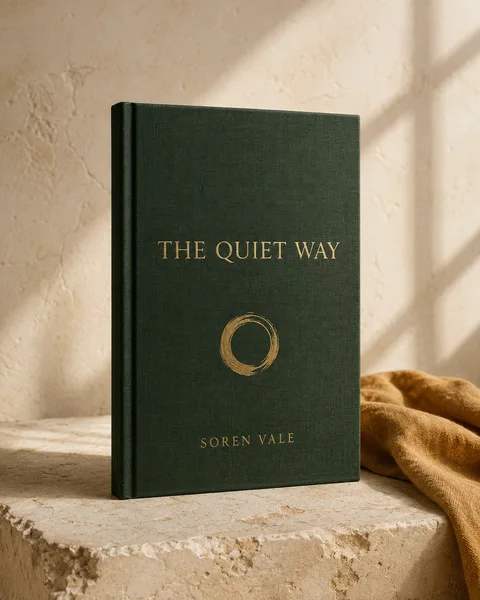
The full book holds twenty reflections, each with a practice, and a seven-day guide for bringing them into ordinary life.
You do not need a different life before you can pay closer attention to this one. You can begin while the kettle warms, before you answer a difficult message, or when you notice that you have been hurrying without knowing why.
This book is a collection of twenty reflections and small practices. It is concerned with ordinary decisions: how we listen, what we promise, when we stop, and how we begin again. There is no finish line at which you become a permanently calm person. The purpose is to make a little more room for a considered choice.
Read one reflection at a time. Try its practice in a situation that is manageable for you. You may disagree with a passage, change an exercise, or leave it alone. A useful book should meet your judgment, not replace it.
The exercises are invitations to reflection, not treatments for medical or mental health conditions. Seek appropriate professional support when you need it. Being thoughtful does not require you to remain in an unsafe situation or to carry a difficulty alone.
Soren Vale is the fictional literary persona and pen name of The Still Monk. The scenes in these pages are illustrative, not accounts of a real monk's life or claims of religious authority. This is an original collection of everyday philosophy, not a presentation of a particular spiritual tradition.
First digital edition, 2026. Published by The Still Monk. For personal reading and reflection. Please do not redistribute or resell this edition. Find the project at thestillmonk.us.
An excerpt from The Quiet Way by Soren Vale, the fictional literary persona of The Still Monk. First digital edition, 2026.